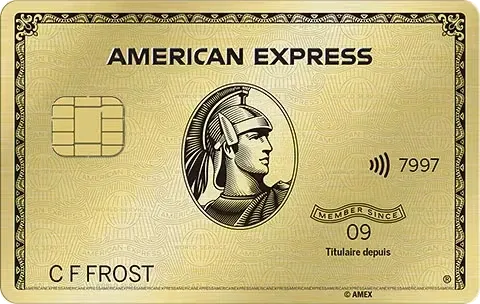
Membership Rewards is the points currency I rate highest in Canada, and the Gold Rewards Card is the sensible way into it. For $250 a year you get the full program: 1:1 transfers to Aeroplan, 2x earning on the categories most households spend in, and a $100 travel credit that brings the real cost closer to $150. The Platinum buys you more kit; this buys you the points engine without the $799 toll.
It earns 2 points per dollar on gas, groceries, drugstores and travel, with everything else at 1. That will not win an earn race against the Cobalt on food, and there is no foreign-fee waiver. What it wins on is balance: broad categories, real transfer partners, and a fee you can mostly credit away.
Welcome offer
The current public offer is up to 60,000 Membership Rewards points, worth about $600 toward travel at the fixed rate and more once transferred to Aeroplan. It pays out monthly: 5,000 points for each monthly billing period in which you spend $1,000 in net purchases, across your first 12 periods. There is no lump-sum tier and no published end date.
Treat it as a subscription, not a sprint. You need $1,000 in every one of those 12 months; a month you miss is 5,000 points you never get back. Worth knowing before you apply: Amex shows increased offers on this card from time to time (in October 2026 its own page was showing some visitors up to 90,000 points, with an extra 30,000 after $4,000 of spending in the first 3 months), so check the current offer before you apply.
Put two or three recurring bills (phone, insurance, streaming, utilities) on the card and the $1,000 monthly minimum mostly takes care of itself. Value the full 60,000 points at $600 as a floor, and closer to $900 or more once transferred to Aeroplan and spent on a good redemption.
Fees & eligibility
The Gold Rewards Card runs $250 a year, with no first-year waiver. The built-in offset is the $100 annual travel credit: use it once a year on an Amex Travel booking of $100 or more and the effective fee drops to about $150. Your first supplementary card is free, and each additional one is $50.
Amex now issues the Gold Rewards as a credit card, not a charge card, at 21.99% on purchases and funds advances. Two missed payments raise that to 25.99%, and three or more to 29.99%, so treat it as a card you pay in full every month. There is no minimum income requirement, making it one of the easier premium travel cards to qualify for.
Earning rewards
Earning is flat and easy to remember: 2 points per dollar in the four categories that cover most household spending, 1 point everywhere else, and an extra point on hotels and car rentals booked through Amex Travel.
The 2x categories are eligible stand-alone gas stations, grocery stores and drugstores in Canada, plus travel: flights, hotels, car rentals, cruises and tours, whether you buy them at home or abroad. None of the accelerated categories carry a spending cap, which matters more than it sounds once your travel spend adds up.
One honest comparison: the American Express Cobalt earns 5 points per dollar on eats and drinks, so if restaurants and groceries dominate your budget, the Cobalt out-earns this card inside the same program. The Gold answers with drugstore coverage, uncapped 2x travel earn, the annual credits, and lounge visits the Cobalt does not have. Plenty of people carry both.
Redeeming rewards
Membership Rewards is the most flexible points currency in Canada, and this card gets the full version of it. The floor is fixed-value travel: book any flight, hotel or package through Amex Travel and redeem at 1 cpp, with no award chart and no blackout dates. The ceiling is transfers.
Points move to Aeroplan at 1:1, instantly, and Amex is the only bank program in Canada that transfers there. British Airways Avios and Flying Blue are also 1:1 (Amex allows up to 5 business days for transfers other than Aeroplan and Delta). On the hotel side, Marriott Bonvoy converts at 1:1.2 and Hilton Honors at 1:1. A well-chosen Aeroplan or Avios redemption routinely returns 1.5 to 2 cpp, which is where this card stops feeling like a 2x earner and starts behaving like a 3 to 4 percent one.
Two things to avoid. Amazon Shop with Points pays just 1,000 points = $7, and most gift cards cost 130 points per dollar, so both fall short of the 1 cpp a plain statement credit gives you. And note one gap: Membership Rewards does not transfer to Singapore Airlines KrisFlyer directly; the only route is through Bonvoy at a poor 3:1.
Perks & benefits
The perk stack is deliberately thinner than the Platinum, and that is the point: you pay for two credits and a taste of lounge access rather than the whole kit. The $100 travel credit lands every year and applies to a single Amex Travel Online booking of $100 or more. The $50 NEXUS credit covers the application or renewal fee once every four years, roughly the cycle NEXUS renews on anyway.
Lounge access is the taste part: four complimentary Plaza Premium visits a year at Canadian airports, plus a Priority Pass membership where every visit is charged at the prevailing rate. Be clear-eyed about the gaps too. There is no foreign-transaction-fee waiver, so purchases abroad cost the standard 2.5% on top, and Amex acceptance in Canada still trails Visa and Mastercard. Most people pair this card with a no-fee Visa or Mastercard for the holdouts.
Insurance
For a $250 card the coverage is respectable, led by $5,000,000 in emergency medical for the first 15 days of a trip. Read the age line closely: emergency medical is only available to travellers under 65. The cancellation and interruption limits are on the low side for a premium card, so a big prepaid trip may still justify a standalone policy. As always, the certificate of insurance is the final word.
My take
If a friend asked me for one card to start collecting points seriously, this is the one I would point to.
The Gold Rewards Card is the value pick of the Membership Rewards lineup, and I say that knowing the Platinum sits one page over. You get the same currency and the same Aeroplan pipeline as the $799 card, at a fee the travel credit cuts to about $150. The trade-offs are real: the current welcome offer is modest and slow, the 2.5% foreign fee means it stays home when you travel abroad, and food-heavy spenders will out-earn it with a Cobalt. Get it if you want Aeroplan-bound points from gas, groceries and travel without a luxury-tier fee. Skip it if you rarely fly, or start with the no-fee Green Card if you just want to test the program first.
The good
- 1:1 Aeroplan transfers at a mid-tier fee
- 2x on gas, groceries, drugstores & travel, uncapped
- $100 travel credit cuts the fee to ~$150
The catch
- 2.5% foreign transaction fee
- Welcome bonus takes 12 months of steady spend
- Only 4 free lounge visits, Canada only