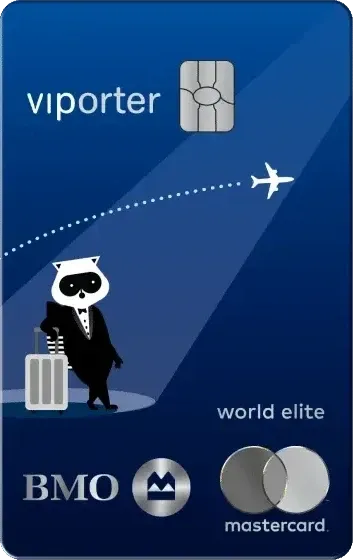
This is an airline card, and airline cards only make sense if you actually fly the airline. The VIPorter World Elite is the card I would point a committed Porter flyer to, and the one I would talk almost everyone else out of. If your travel runs through Toronto, Ottawa, Montreal, Halifax or Porter's growing western routes, keep reading; if it does not, an Aeroplan or flexible-points card will serve you better.
What it does well is stack Porter-specific value. You get automatic VIPorter Venture status, a free first checked bag and carry-on for you and up to eight companions on the same booking, priority airport treatment, and 3x points on Porter purchases. The catches are the ones every co-branded card carries, and I get into them below: a 2.5% foreign transaction fee, points that only buy Porter seats, and a network that is still heavily weighted to Eastern Canada.
Welcome offer
The BMO VIPorter World Elite Mastercard is currently offering up to 70,000 VIPorter points, which BMO values at about $1,050 in Porter flights, or 1.5 cents per point (cpp) based on its 2024 average flight redemption, plus a round-trip companion pass along the way.
The bonus arrives in three stages: 20,000 points after you spend $5,000 in the first 110 days, another 20,000 points plus the companion pass after $9,000 in the first 180 days, and a final 30,000 points after $18,000 in the first year. Applications must be received by October 31, 2026 to qualify for this offer.
Be honest with yourself about that spending ladder before you apply. Clearing all three tiers means putting $18,000 through the card in a year, about $1,500 a month, and the companion pass alone requires $9,000 in 180 days. The first 20,000 points are the easy part; the rest reward heavy, steady spend.
The value is only real if you fly Porter. Seventy thousand points is roughly $1,050 toward Porter fares, but zero toward anyone else's flights. Treat the companion pass at the $9,000 tier as the sweetener: a second round-trip seat for the cost of taxes and fees, which on a longer Porter route can be worth more than the points.
Fees & eligibility
The card runs $199 a year, and BMO waives the fee for the first year, so you can test the perks and welcome bonus before paying anything. Additional cards cost $75 a year each, and authorized users get the Porter perks too: they become Avid Travellers automatically and get the bag, seat and priority benefits on their own bookings.
As a World Elite Mastercard it requires a personal income of $80,000 or a household income of $150,000, a higher bar than most Visa Infinite travel cards. And the standing reminder for any rewards card: at BMO's standard 21.99% purchase rate, the points only come out ahead if you clear the balance in full every month.
Earning rewards
Earning is built around Porter and a handful of everyday categories, all of it in VIPorter points. Porter purchases earn the top rate of 3 points per dollar, on up to $20,000 of Porter spend per year. That covers fares, seat upgrades and onboard extras booked with Porter.
Away from the airline you earn 2 points per dollar in three buckets, each with its own annual cap: gas and everyday transportation up to $5,000, groceries and dining up to $10,000 combined, and hotels up to $5,000. Everything else, and any spend above those caps, earns 1 point per dollar.
The honest read is that the everyday rates are fine, not leading. A no-annual-fee cash-back card matches or beats 2x on groceries once you account for what a VIPorter point is worth, so the reason to route daily spend here is to hit the welcome tiers and pad your Porter balance, not because the earn rate wins on its own.
Redeeming rewards
VIPorter is a revenue-based program, so it does not work like a fixed-value bank currency. Any Porter seat that is available for cash can also be booked with points, with no blackout dates, and the points price rises and falls with the cash fare. In practice the value tracks the cash fare, and BMO puts the average flight redemption at about 1.5 cpp.
Because pricing tracks the fare, there is no award chart to master, but there are published floors. A one-way domestic short hop like Toronto to Ottawa or Montreal starts around 5,000 points, medium routes around 7,000, and longer domestic flights such as Toronto to Vancouver from about 8,000 points. Cash-plus-points bookings, where you cover part of a fare with points, often squeeze out the best value, and Porter runs periodic redemption sales that can push a point well past 2 cpp.
The ceiling is real but narrow: points also book partner flights on Air Transat (Caribbean from about 21,500 points, Europe from about 25,000) and on Alaska Airlines for transborder routes that include a Porter leg. The hard limit is that VIPorter points buy Porter and partner seats only. There is no transfer to Aeroplan, Avios or any other program, so the entire value of this currency depends on Porter flying where you want to go.
Perks & benefits
The perks are where this card earns its keep, and they are almost all Porter perks. Holding it grants automatic VIPorter Venture status, plus a free first checked bag and carry-on for you and up to eight companions on the same booking, complimentary PorterClassic seat selection (rows 8 and back) for the same group, priority check-in, security and boarding, and priority rebooking when flights are delayed. For a family or a group of friends flying together, the bag waiver alone can cover the annual fee in a single trip.
Two extras round it out. A round-trip companion pass arrives after $9,000 of spend in your first 180 days (then one each card year in which you spend $50,000), letting a second traveller fly for just taxes and fees. And a grocery credit, six months of Instacart+ plus $10 a month back on Instacart orders of $50 or more, adds everyday value for the first half-year.
One perk to read carefully: the card includes a Mastercard Travel Pass membership through DragonPass, but lounge visits are not complimentary. Each visit costs about US$32, so this is a discounted door, not free lounge access. If lounges are your priority, a card with included passes is the better fit.
Insurance
The insurance is a solid mid-tier package for a $199 card, with one limitation to flag up front: emergency medical covers only the first 21 days of a trip and applies to travellers 64 and under, so anyone 65 or older, or taking a longer trip, needs a separate policy. Trip cancellation and interruption are included, along with flight and baggage delay, rental-car collision and loss coverage (secondary to any other insurance you carry), and standard purchase protection. Coverage is underwritten by CUMIS; confirm the current certificate of insurance for exact terms before you rely on any of it.
My take
If you fly Porter more than once or twice a year, this is the card I would name first; if you do not, I would skip it without a second thought.
Co-branded airline cards live or die on one question: do you fly the airline? For a Porter regular the answer here is easy. The free checked bag for you and up to eight companions, automatic Venture status and 3x on fares add up fast, and the first year is free while you find out. The problems are the ones you would expect. The 2.5% foreign transaction fee makes it a poor card to travel abroad with, the points only buy Porter and its partners, and Porter's network, though expanding west, still leans heavily on Eastern Canada. For most Canadians, an Aeroplan card reaches far more of the country and the world on Air Canada's network, which makes it the more broadly useful pick. Get this one if Porter is really part of how you travel; skip it if it is just an airline you have heard good things about.
The good
- Free checked bag for you and up to 8 companions
- Automatic VIPorter Venture status
- 3x on Porter, first year free
The catch
- 2.5% foreign transaction fee
- Points buy Porter and partners only
- Lounge visits cost about US$32 each