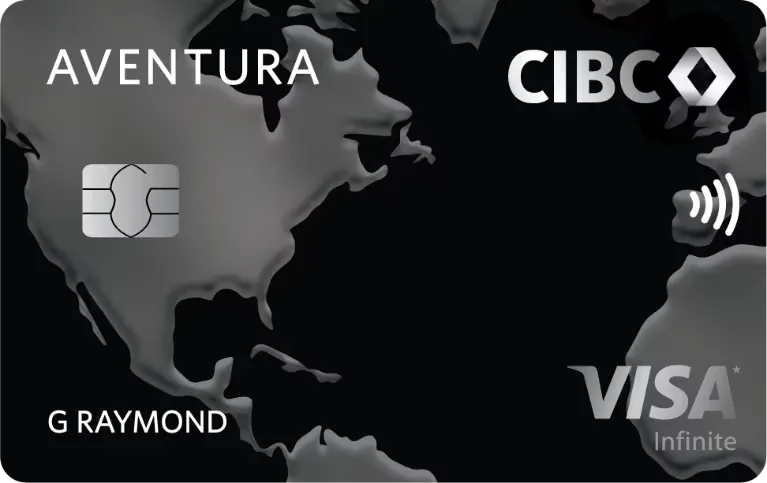
Every bank wants to sell you its own points, and Aventura is CIBC's version. It is the card I point people to when they say they want travel rewards but do not want the homework of one airline's program: the points book any airline, any hotel, any travel expense, and the floor value is a predictable 1 cent per point (cpp).
The quiet upside is the Aventura Airline Rewards chart, a fixed table that lets a well-chosen economy flight return two cents a point or better. Add four airport lounge visits a year, a NEXUS rebate, and a first year that costs nothing under the current offer, and you get a solid, low-commitment travel card. Just know its limits: the earn rates are modest, and it still charges foreign transaction fees.
Welcome offer
The current offer is worth up to 60,000 Aventura Points: 15,000 on your first purchase, another 30,000 once you spend $3,000 in the first four monthly statement periods, and a final 15,000 once your spend in that same window reaches $5,000. CIBC also rebates the $139 first-year annual fee, for you and up to three additional cardholders at $50 each, if they are added when you apply.
That 60,000 is worth about $600 at the guaranteed floor of 1 cpp toward travel, and CIBC puts it at up to $1,200 through the Aventura flight chart. Offer figures rotate, so confirm the numbers on the application page before you apply.
The first two milestones are gentle: $3,000 over four statement periods is about $750 a month, which groceries, gas and a bill or two clear on their own. Pushing to $5,000 for the last 15,000 points is the only real stretch. With the first-year fee rebated, the offer is essentially free to try.
Fees & eligibility
The card runs $139 a year, rebated for the first year under the current offer, with additional cards at $50 each (also rebated in year one, up to three added when you apply). As a Visa Infinite product it asks for a personal income of $60,000 or household income of $100,000.
There is a way to make the fee disappear permanently: once your CIBC Smart Account reaches Tier 3, with $100,000 or more in deposits and investments at CIBC, the bank rebates the $139 annual fee every year, plus up to three additional cards at $50 (Tier 2, at $40,000, rebates only $50). That only makes sense if you would bank with CIBC anyway.
One more line item that matters on a travel card: purchases in a foreign currency add the standard 2.5% foreign transaction fee. If you spend a lot abroad, plan to pair this card with a no-FX card for those purchases.
Earning rewards
Earning is simple and, frankly, middle of the pack. The top rate of 2 points per dollar only applies to travel booked through the CIBC Rewards Centre, CIBC's own travel agency, so most people will rarely see it.
The rate that does the everyday work is 1.5 points per dollar at gas stations, EV charging stations, grocery stores and drug stores. Those are broad, useful categories with no rotating calendar and nothing to activate, though the 1.5x stops once total card spending (every purchase counts) passes $80,000 in a year. Everything else earns 1 point per dollar.
At the 1 cpp floor, 1.5 points per dollar works out to about 1.5% back on groceries and gas, respectable rather than exciting. If raw earn rate is what you care about, a card like the American Express Cobalt or the Scotiabank Gold American Express earns far more on food; this card wins on what the points can do, not how fast they arrive.
Redeeming rewards
Aventura has two speeds. The slow, safe one: redeem points at a fixed 1 cpp against any travel booked through the CIBC Rewards Centre, flights on any airline, hotels, packages. Predictable, no blackouts, no strategy required.
The fast one is the Aventura Airline Rewards chart, and it is the reason to prefer this card over a plain fixed-value card. The chart prices economy flights in bands by destination: a short-haul Canada or U.S. flight runs 10,000 to 20,000 points for a base fare up to $400, a long-haul Canada to U.S. flight runs 25,000 to 35,000 points for a fare up to $800, and Europe runs 50,000 to 70,000 points for a fare up to $1,300. Hit the top of a band and a point returns around 2 to 2.3 cpp, roughly double the floor.
Two honest caveats. The chart covers the base fare only, so taxes and fees go on your card or cost extra points. And the points required scale with the fare inside each band, so the headline values need a fare near the band maximum. Statement credits and gift cards redeem below the travel rate; treat those as a last resort.
Perks & benefits
The headline perk is four complimentary airport lounge visits a year through the Visa Airport Companion Program (powered by DragonPass), covering 1,200+ lounges worldwide; extra visits run about US$32 each. Four is enough for a couple of round-trips a year, though frequent flyers will notice it is fewer than the six the Scotiabank Passport hands out.
The rest is a practical bundle: a rebate on one NEXUS application fee every four years (up to $200, which CIBC values at about $160), up to 10 cents per litre off gas at Pioneer, Fas Gas, Ultramar and Chevron when you link the card to Journie Rewards, a free first year of Skip+ (a $110 value, current promotion), and mobile device insurance up to $1,000. Standard Visa Infinite extras like the concierge, hotel collection and dining events round it out. The gap in the armour is the one already mentioned: no foreign-fee waiver.
Insurance
The insurance package is stronger than the fee suggests, headlined by up to $5 million in out-of-province emergency medical for the first 15 days of a trip (only the first 3 days once you turn 65). Trip cancellation and interruption, rental-car coverage and the usual purchase protections are all here; the baggage and delay limits are on the modest side. Coverage is underwritten with the usual conditions and exclusions, so read the certificate of insurance before you rely on it.
My take
This is the card I suggest when someone tells me they want travel points but their eyes glaze over at award charts and transfer partners.
The pitch is simplicity with a bonus round. Your points are always worth at least 1 cpp on any travel, and if you feel like playing, the flight chart doubles that on the right economy fare. The first year is effectively free, the lounge visits and NEXUS rebate are real money, and the whole thing asks very little of you. What it is not: a card for optimizers, who will squeeze more from Aeroplan or Amex points, or a card for spending abroad, where the 2.5% FX fee bites. Get it if you want flexible, low-effort travel value from a big-bank card; skip it if you are chasing outsized redemptions or need a no-FX travel companion.
The good
- First year effectively free
- Flight chart can beat 2 cents a point
- 4 lounge visits + NEXUS rebate
The catch
- 2.5% foreign transaction fee
- No transfer partners
- 2x rate only via CIBC's own portal