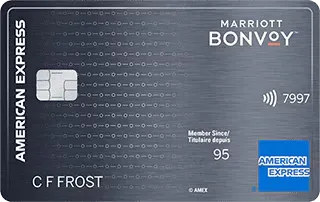
Most cards make you do math. This one asks a single question: do you sleep in Marriott-family hotels? With more than 9,000 properties across 30-plus brands, from Courtyard and Fairfield up to Westin, St. Regis and The Ritz-Carlton, the honest answer for a lot of Canadians is yes, at least a few nights a year.
If that's you, I think this is the easiest $120 in Canadian credit cards. Every card anniversary you get an Annual Free Night Award good for a room costing up to 35,000 points, the kind of room that routinely sells for $250 or more in cash. Add 15 Elite Night Credits that do most of the work toward real status, and the card pays for itself before you've put a single purchase on it. It is not a great everyday earner and I wouldn't pretend otherwise; it's a standing annual coupon that happens to be shaped like a credit card.
Welcome offer
The Marriott Bonvoy American Express Card currently offers up to 70,000 Bonvoy points, worth roughly $560 in hotel stays at typical redemption values.
You'll earn 60,000 Bonvoy points after spending $3,000 in your first three months. A further 10,000 points arrive after you spend $500 in your 13th month of cardmembership, a small nudge to keep the card into year two, which is exactly when the first Annual Free Night Award lands. This is the standard public offer with no posted end date, and current or former cardmembers are not eligible.
The $3,000 in 90 days is an easy clear for most households, especially with free additional cards pooling family spend. The month-13 tranche is really a retention sweetener: by the time you earn it, your first Free Night Award has also arrived, so year two's $120 fee is covered before you decide whether to keep the card.
Fees & eligibility
The card runs $120 a year with no first-year waiver, and additional cards are free, which is unusual and useful for pooling household spend toward the welcome offer. Amex lists no minimum income requirement for this card; approval rests on your credit profile. Interest runs 21.99% on purchases and 21.99% on funds advances, so as always, the rewards only make sense if you clear the balance every month.
Two running costs to know about. The card charges the standard 2.5% foreign transaction fee, so it is not the card to spend on abroad, even at a Marriott. And it is an American Express, which still meets acceptance gaps at some Canadian grocers and independent shops; most people pair it with a Visa or Mastercard rather than carrying it alone.
Earning rewards
The earn structure is two rates and no fine print. Purchases at Marriott Bonvoy properties earn 5 points per dollar, and that covers the entire folio charged to the card: room, taxes, resort fees and the room-service burger included. It stacks on top of the points you already earn as a Bonvoy member for staying, which is 10 points per US dollar at most brands before any status bonus, so a paid stay charged to this card earns from three directions at once.
Everything else earns 2 points per dollar. At a typical Bonvoy value of 0.7 to 0.9 cents per point (cpp), that works out to roughly 1.4 to 1.8 percent back, which is fine but beatable. A Cobalt earns far more on food, and most flat-rate cards match this one without the redemption homework. The honest playbook: put Marriott stays and not much else on this card, and let the anniversary free night and the Elite Night Credits carry the value.
Redeeming rewards
Bonvoy dropped its published award chart in favour of dynamic pricing, so a night costs whatever Marriott says it costs that day, from about 5,000 points at basic properties to 200,000-plus at the trophy resorts. In practice points are reliably worth about 0.7 to 0.9 cpp: a 35,000-point redemption typically replaces a room that would cost $250 or more in cash. Two rules do the heavy lifting. Award stays are fully refundable until the cancellation deadline, so book early and rebook if the price drops. And every fifth night on an all-points booking is free, which quietly turns 0.8 cpp into 1 cpp on five-night stays.
Bonvoy is also the rare hotel program whose points move to airlines at a usable rate. Roughly 40 partners convert at 3:1, and most add a 5,000-mile bonus per 60,000 points transferred, so 60,000 Bonvoy becomes 25,000 airline miles. Always transfer in 60,000-point blocks, since the bonus ignores partial amounts. One detail worth knowing: Membership Rewards in Canada has no direct Singapore Airlines KrisFlyer partnership, so MR to Bonvoy to KrisFlyer is the only route into that program from Canada. It is a lossy path you use for one specific award, not a habit.
Perks & benefits
The card exists for one benefit: the Annual Free Night Award, issued on each card anniversary from year two onward, good for a night costing up to 35,000 points. Since March 2026 you can top any award up with up to 25,000 points from your own account, stretching it to 60,000-point rooms, which covers a Delta Hotels in downtown Toronto, an Autograph Collection in Montreal or a JW Marriott in Kuala Lumpur. Use it on a $250 room once a year and the $120 fee comes back roughly twice over before counting anything else. Two catches: the award books standard base rooms only, and it expires 12 months after issue, so plan a trip around it rather than letting it die in your account.
The quieter half of the value is status. The card grants Silver Elite automatically, which is honestly a modest tier, and deposits 15 Elite Night Credits into your account every calendar year, which is the part that matters. That is more than half of the 25 nights needed for Gold and nearly a third of the way to Platinum, the tier where free breakfast and lounge access begin. Spend $30,000 on the card in a year and Gold Elite is granted outright. Note the credits do not stack with the Business version of the card; holding both still gives 15.
Insurance
This is the card's weakest flank, and worth reading before you assume it covers a trip. There is no emergency medical coverage and no trip cancellation or interruption insurance, the two protections that matter most when travel goes wrong. What you do get is respectable day-to-day cover: primary rental car insurance, flight and baggage delay coverage, and purchase protection. Carry medical and cancellation cover on another card or a standalone policy, and treat this one as the card that books the room, not the one that protects the trip.
My take
This is the card I tell Marriott people to get first, and the one I tell everyone else to skip entirely.
The everyday earn rate will not impress anyone, the FX fee stings, and the insurance gaps are real. None of that is the point. You are buying a 35,000-point hotel night for $120 a year, plus 15 Elite Night Credits that make Gold trivial and put Platinum within reach for anyone who travels a little. Used with any intention at all, the free night alone returns about double the fee. Get it if you stay at Marriott brands even a few nights a year and will actually plan around the anniversary night; skip it if your hotel life is Airbnbs and independents, because without the stays the whole thesis collapses.
The good
- Free night worth more than the fee
- 15 Elite Night Credits a year
- No income requirement, free additional cards
The catch
- Weak 2x earn on everyday spend
- No emergency medical or trip cancellation insurance
- 2.5% foreign transaction fee