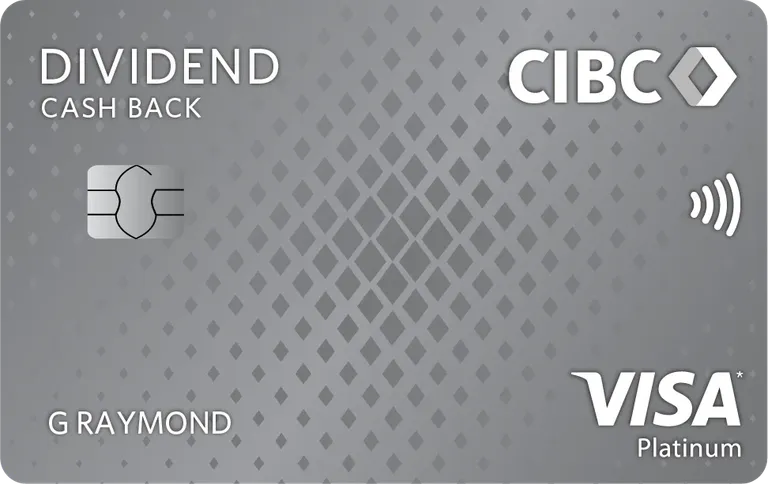
The Dividend Platinum is the card I'd point to if you want CIBC's grocery and gas cash back but don't meet the Dividend Visa Infinite's income bar. CIBC asks for only $15,000 in household income, and you get 3% on groceries, gas and EV charging plus 2% on dining, transit and recurring bills for $99 a year, rebated in year one.
The catch is that the Infinite pays 4% in the same categories for $21 more, and lets you spend more before the bonus rates run out. So I'd treat the Platinum as the choice for people who can't get the Infinite, or who would rather not pay $120 for the extra point.
Welcome offer
CIBC is advertising up to $300 in value for new cardholders, verified on the CIBC page on October 13, 2026. The main part is 10% cash back on net purchases in your first 4 monthly statements, up to $2,000 in purchases, which works out to $200. Regular earn rates don't stack on top, so those first $2,000 earn 10% flat whatever the category.
You also get a $50 bonus for setting up one recurring bill payment that posts within the first 4 statements, and a first-year annual fee rebate CIBC values at $99, which also covers up to 3 authorized users added when you apply. The offer applies to cards approved from July 16, 2026, shows no end date, and is off the table if you opened, transferred or cancelled another CIBC Dividend card in the last 12 months, so confirm the current terms on the issuer's page.
The $2,000 cap is low enough that ordinary spending clears it in a month or two, so there is nothing to sprint for. Move a phone, internet or streaming bill onto the card in the first statement to lock in the $50, and leave it there, since recurring payments keep earning 2%.
Fees & eligibility
The card costs $99 a year, rebated in the first year as part of the welcome offer. Authorized users cost $30 each, up to 3, and their first-year fees are rebated too if you add them on the application. A CIBC Smart Account at Tier 2 or Tier 3 can rebate the fee every year (up to $50 at Tier 2, up to $139 for the primary cardholder at Tier 3, which covers it in full).
Approval needs a household income of $15,000, and the card comes with a minimum credit limit. Interest is 21.99% on purchases and 22.99% on cash advances, balance transfers and convenience cheques (21.99% for Quebec residents). Purchases in a foreign currency carry a 2.5% conversion fee, and the cash back only comes out ahead if you pay the balance in full each month.
Earning rewards
The top tier is 3% cash back at grocery stores and supermarkets, gas stations and on EV charging. The middle tier is 2% on local transit and ride sharing in Canada, restaurants and bars, recurring bill payments, and travel booked through CIBC by Expedia. Everything else earns 1%, with no limit on total cash back.
The limits are tighter than on the Infinite. The 3% and 2% rates apply to the first $20,000 a year in those categories or the first $30,000 in total card purchases, whichever comes first, and then everything earns 1% until the limits reset. Categories follow how Visa codes the merchant, so a big-box store that sells groceries may not count as a grocery store.
Redeeming rewards
Redemption is a statement credit on demand. Once your balance reaches $10, the primary cardholder can redeem through CIBC Online Banking or the mobile app, and the credit lands within 5 days.
Cash back does not expire, and there is no limit on how much you can earn. Balances under $10 can be redeemed by phone between December 1 and March 31. Authorized users earn for the account but cannot redeem.
Perks & benefits
Perks are everyday rather than travel. The most useful is Journie Rewards: link the card and save up to 10 cents per litre at participating Pioneer, Fas Gas, Ultramar and Chevron stations, on top of the 3% the card already pays on gas.
You also get a free Skip+ membership when the card is linked, 50% off Disney+ Standard with Ads for 6 months, and discounts of up to 30% at Avis and 35% at Budget on Pay Now base rates. There is no lounge access, no Visa Infinite concierge or hotel program, and no foreign transaction fee waiver.
Insurance
The insurance is short, underwritten by Belair. Car rental collision and loss damage coverage is primary insurance for rentals up to 48 days on cars with an MSRP up to $85,000, with no deductible, as long as the full rental is charged to the card and you decline the agency's CDW. Common carrier accident insurance pays up to $500,000 when at least 75% of the fare is on the card.
New purchases are covered for 90 days against loss, theft or damage, and manufacturer warranties are doubled for up to 1 extra year, with a $60,000 limit per cardholder. There is no travel medical, trip cancellation, flight delay, baggage or mobile device coverage, so buy a separate travel medical policy before you leave the province.
My take
I'd get the Dividend Platinum if groceries, gas and bills are your big categories and you don't qualify for the Dividend Visa Infinite; if you do qualify, I'd pay the extra $21 for the Infinite's 4%.
Next to the Infinite, the Platinum gives up a full point in the top categories (3% against 4%), a lower total-spend ceiling ($30,000 against $50,000), and the Infinite's mobile device and short travel medical coverage. In exchange you save $21 a year and need only $15,000 in household income instead of $60,000 personal or $100,000 household.
Against CIBC's no-fee Dividend Visa, which pays 2% on groceries and 0.5% on everything else, the Platinum has to earn back $99 a year from year two. A household with steady grocery, gas and bill spending should clear that, and a Smart Account at Tier 3 removes the fee altogether. If your card spending is light, I'd stay with the no-fee version.
The good
- 3% on groceries, gas and EV charging, plus 2% on dining, transit and bills
- First-year fee rebated, plus 10% back on your first $2,000
- Only $15,000 in household income needed
The catch
- Bonus rates stop after $20,000 a year in categories or $30,000 in total spend
- No travel medical or mobile device insurance; 2.5% FX fee
- The Dividend Visa Infinite pays 4% for $21 more a year