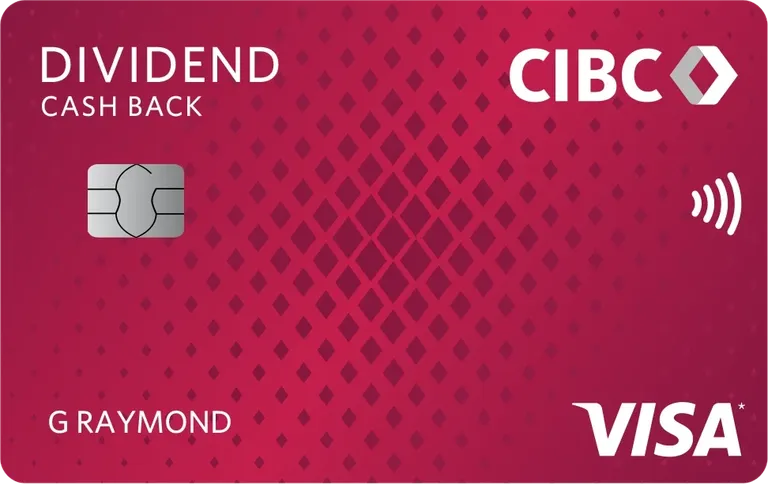
The Dividend Visa is the no-fee version of CIBC's cash back line, and I'd point to it for someone who wants a simple card for groceries and daily spending with a very low bar to get in. Groceries earn 2%, gas, EV charging, transit, dining and recurring bills earn 1%, and the household income requirement is only $15,000.
The weak spots are the 0.5% base and the annual limits. The 2% and 1% rates stop after $20,000 in category spending or $30,000 in total card spending a year, and everything after that earns 0.5%. From what I can tell, it suits lighter spenders best, and there is no welcome offer on the page right now.
Welcome offer
There is no welcome bonus on the CIBC Dividend Visa at the moment. CIBC's product page lists the earn rates, the $0 fee and the partner perks, but no sign-up offer, as of October 13, 2026.
CIBC runs welcome offers on its other Dividend cards from time to time, so check the issuer's page before applying in case one has appeared on this card.
With no bonus to chase, the value is all in ongoing earning. Groceries at 2% is the category that does the work, so route your grocery spend here even if another card handles everything else.
Fees & eligibility
The annual fee is $0, with $0 for up to 3 additional cards. The household income requirement is $15,000 a year, and CIBC notes that the card has a minimum credit limit. Purchases carry a 21.99% interest rate and cash advances, balance transfers and convenience cheques 22.99% (21.99% for Quebec residents), rising to 25.99% and 27.99% if required payments are missed.
Your payment due date is at least 21 days after the statement date, and purchases paid in full by then carry no interest. Purchases in a foreign currency carry a 2.5% conversion fee, so this is not a card for travel spending.
Earning rewards
Earning is three tiers. Groceries earn 2%; gas and EV charging, local transportation (transit, taxis and rideshare), dining, recurring payments and travel booked through CIBC by Expedia earn 1%; everything else earns 0.5%.
The 2% and 1% rates, other than CIBC by Expedia, apply to the first $20,000 in net annual category purchases or the first $30,000 in total net annual card purchases, whichever comes first. After that, every purchase earns 0.5% until the limits reset after your December statement.
Redeeming rewards
Redemption is flexible. Once your balance reaches $10, you can redeem cash back any time through CIBC Online Banking, the Mobile Banking App or by phone, and it is credited to your card account within 5 days.
Only the primary cardholder can redeem, and cash back does not expire while the account is open and in good standing. Balances under $10 can be redeemed by phone between December 1 and March 31, and you can set an alert for when your balance reaches an amount you choose.
Perks & benefits
The perks are partner savings rather than card benefits. Link the card to Journie Rewards to save up to 10 cents per litre at participating Pioneer, Fas Gas, Ultramar and Chevron stations, and link it to Skip for a free Skip+ membership with $0 delivery fees, plus a $10 monthly voucher after four orders of $30 or more in a month.
You also get 50% off Disney+ Standard with Ads for 6 months as statement credits, up to 30% off Avis and 35% off Budget base rates on Pay Now bookings, and CIBC Global Money Transfers to more than 120 countries with a $0 transfer fee. There is no travel credit or lounge access.
Insurance
The insurance covers purchases only. Purchase Security protects eligible items against loss, theft or damage for 90 days from purchase, and Extended Protection doubles the manufacturer's warranty by up to 1 extra year. Claims under both share a $60,000 total limit per cardholder across all CIBC cards.
There is no travel insurance of any kind: no emergency medical, trip cancellation, delay, baggage, rental car or mobile device coverage. If you rent cars or travel, use another card or buy coverage separately.
My take
I'd get the Dividend Visa if you want a free card for groceries and everyday bills and you spend well under $30,000 a year on it; I'd skip it if you spend heavily or want a welcome bonus.
For a no-fee card, 2% on groceries and 1% on a broad list of everyday categories is decent, and redeeming any time from $10 is easier than waiting for an annual payout. The $15,000 household income bar also makes it one of the easier cash back cards to get.
What I'd weigh is the 0.5% base and the limits. Once you pass $20,000 in category spending or $30,000 overall in a year, the card drops to 0.5% on everything until the next December statement. If your grocery and gas spending is high and you clear $60,000 in personal income, the Dividend Visa Infinite pays 4% on those categories for a $120 fee.
The good
- No annual fee, including up to 3 additional cards
- 2% on groceries and 1% on gas, transit, dining and bills
- Redeem cash back any time from $10
The catch
- 0.5% base rate on everything else
- Bonus rates stop at $20,000 in categories or $30,000 total a year
- No welcome offer and no travel insurance