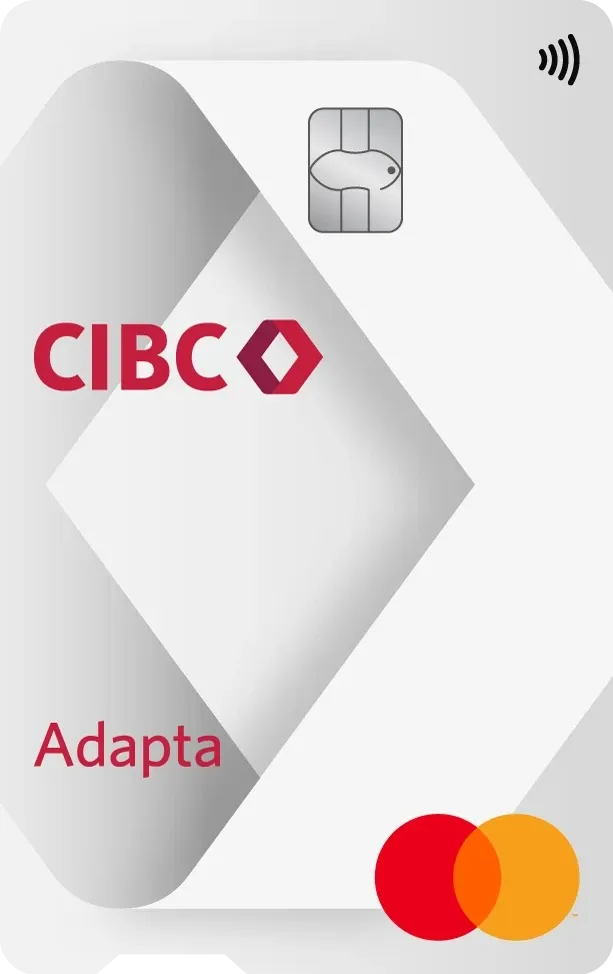
This is the Adapta I'd point a student to, because the student version gets the better deal. It has the same earn as CIBC's regular Adapta Mastercard: each month it looks at where you spent the most across 12 categories and pays 1.5 points per dollar on the top 3, 2 points on CIBC by Expedia travel and 1 point on everything else, with no annual fee and nothing to register.
What changes for students is the entry bar and the offer. There is no minimum income, the credit limit goes up to $5,000, and the welcome offer is up to 15,000 points against 6,000 on the regular card. The points are worth about 0.67 cents per point (cpp) against your balance or 0.83 cpp toward a CIBC product like a TFSA, so the top-3 rate is roughly 1% to 1.25% back, which I'd call fair rather than exciting.
Welcome offer
CIBC is advertising up to 15,000 Adapta Points on this card, verified on the CIBC page on October 13, 2026, for new cards approved from October 1, 2026. You get 3,000 points after a first purchase, 9,000 points for $1,000 in net purchases, and 3,000 points when the primary cardholder sets up one recurring bill payment that posts, all within the first 4 monthly statements. The spend target works out to $250 a month, which a normal student budget can reach.
CIBC's headline of up to $280 in value counts the points at $125 toward CIBC financial products ($100 against the card balance), plus a first-year Skip+ membership ($110) and roadside assistance ($50). No end date is printed, transfers from other CIBC cards are excluded, authorized users are not eligible for the recurring-bill bonus, and you are not eligible if you opened, transferred or cancelled another Adapta card in the last 12 months, so confirm the current terms on the issuer's page before applying.
Move one recurring bill, such as a phone plan or a streaming subscription, onto the card in the first month. It earns the 3,000-point recurring-bill bonus (points arrive 8 to 12 weeks after the first payment posts) and counts toward the $1,000 spend target at the same time.
Fees & eligibility
The card has no annual fee, and up to 3 additional cardholders are $0. There is no minimum income requirement (the regular Adapta asks for $15,000 in household income). Canadian students can get a credit limit of up to $5,000 with a strong credit score, and international students up to $2,000, subject to CIBC's credit criteria; the card carries a minimum credit limit.
The product page lists 21.99% on purchases and 22.99% on cash advances, balance transfers and convenience cheques (21.99% for Quebec residents). Foreign currency purchases carry a 2.5% conversion fee, and new purchases get a 21-day grace period. With rewards near 1%, any interest erases them, so pay in full every month.
Earning rewards
Every statement period, the card ranks your spending across 12 categories and pays 1.5 Adapta Points per dollar in your top 3. The categories are grocery and drug stores, pet stores, dining and drinks, gas and EV, transit and parking, entertainment, e-games and subscriptions, home improvement, electronics, clothing, health and beauty, and hotels and motels. Travel booked through CIBC by Expedia earns 2 points per dollar, and everything else earns 1 point per dollar.
You don't pick or register anything; the ranking is automatic and follows how merchants are coded in the card network. A wholesale store or online retailer may not land in the category you expect.
Redeeming rewards
Adapta Points have fixed cash values. 1,500 points = $10 toward your card balance or a recent purchase, about 0.67 cpp, with a 1,500-point minimum. 1,200 points = $10 toward select CIBC financial products such as a TFSA, RRSP, Investor's Edge account, line of credit or mortgage, about 0.83 cpp, with a 1,200-point minimum.
For a student, a CIBC TFSA or line of credit is the realistic way to get the higher value; the full 15,000-point welcome offer is worth $125 that way or $100 against the balance. Only the primary cardholder can redeem, and if you close the account the points must be redeemed within 60 days or they are forfeited.
Perks & benefits
The headline extra is roadside assistance from Dominion Automobile Association, rare on a no-fee card. The primary cardholder gets 3 service calls a year in Canada and the continental U.S., covering towing to the nearest repair shop within 5 km, battery boosts, flat tire changes, fuel delivery (you pay for the fuel), lockouts and winching. Coverage starts within three business days of your first purchase.
Students also get a free SPC+ membership (up to 30% off at 450+ brands) for as long as they hold an eligible CIBC student product, registered through CIBC online or mobile banking. The CIBC-wide extras apply too: Journie Rewards savings of up to 10 cents per litre, a free Skip+ membership with a linked card, and 50% off Disney+ Standard with Ads for 6 months. There is no lounge access, no travel credit and no foreign transaction fee waiver.
Insurance
The insurance covers purchases only, under the same Belair certificate as the regular Adapta cards. Purchase Security covers eligible items against loss, theft or damage for 90 days, and Extended Warranty doubles the manufacturer's warranty by up to 1 extra year, with a $60,000 total limit per cardholder across all CIBC cards.
There is no travel medical, trip cancellation, baggage, rental car, common carrier accident or mobile device coverage, so a semester abroad or a trip home needs separate travel insurance.
My take
I'd get this card if you're a student who wants a no-fee card that rewards whatever you spend on most; I'd skip it if nearly all your spending is groceries.
The automatic top 3 suits a student budget that shifts from month to month, and the 1 point base rate (about 0.67% to 0.83% back) beats the 0.5% base on CIBC's Dividend Visa for Students. The welcome offer is the other draw: 15,000 points for $1,000 in four statements and one recurring bill is worth $100 to $125, more than double what the regular Adapta offers.
The ceiling is still low. At 0.67 cpp the top-3 rate is about 1% back, while the Dividend Visa for Students pays 2% at grocery stores, and the 2.5% foreign transaction fee hurts anyone studying abroad. I'd pick the Adapta if your spending is spread across dining, transit, subscriptions and shopping, and the Dividend if groceries dominate.
The good
- No annual fee and no minimum income
- 1.5x on your top 3 categories, picked automatically each month
- Welcome offer of up to 15,000 points, plus roadside assistance
The catch
- Points worth only 0.67 to 0.83 cpp
- 2.5% foreign transaction fee
- Purchase-only insurance, no travel coverage