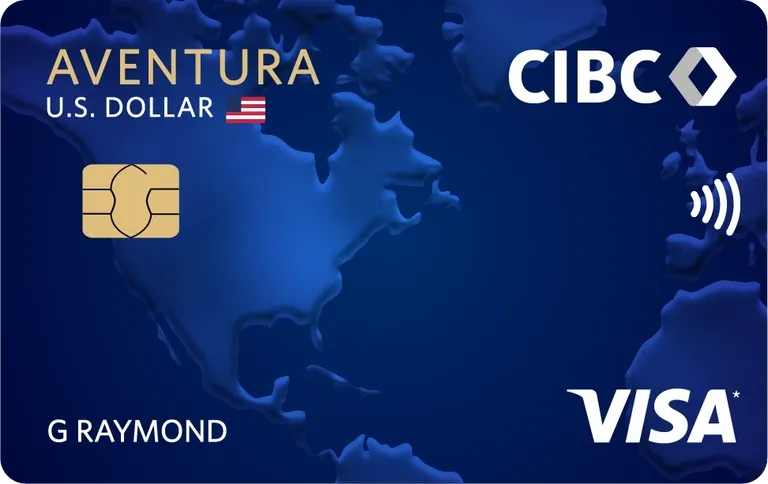
This is CIBC's card for people who already live partly in U.S. dollars: snowbirds, cross-border shoppers, freelancers paid by U.S. clients. Purchases are charged and paid in U.S. dollars, so a US$100 bill in Florida is US$100 on the statement, and if you pay it from a CIBC US$ Personal Account nothing gets converted at either end. I'd point it at existing CIBC clients first, because the card can only be paid from CIBC accounts.
At US$35, rebated in year one, it costs less than the TD (US$39), BMO (US$49) and RBC (US$65) U.S.-dollar cards, and none of those three shows a sign-up bonus on its page right now. The earn is thin (1 point per $2), there is no travel medical, and Canadian-dollar purchases get converted with a 2.5% fee, so it's a second card for U.S. spending only.
Welcome offer
The offer is up to 2,500 Aventura Points plus a first-year annual fee rebate, with no spending requirement. You get 500 points for each of five activities completed within 60 days of approval: sharing your email address with CIBC, signing up for eStatements, adding an authorized user, holding an eligible CIBC chequing account (the CIBC US$ Personal Account counts) and adding the card to Apple Pay, Samsung Pay or Google Pay.
CIBC values the 2,500 points at $25 toward travel booked through its Rewards Centre. The fee rebate covers the primary cardholder's US$35 for the first year and shows up within two statements. The offer applies to new accounts approved from July 16, 2026, has no printed end date, and excludes anyone who opened, transferred or cancelled another Aventura card in the last 12 months.
Three of the five activities take a few minutes in online banking, and if you already bank with CIBC you may qualify for the chequing-account points without doing anything. Adding a free authorized user earns another 500, so all 2,500 points are within reach without spending a dollar.
Fees & eligibility
The card costs US$35 a year, charged in U.S. dollars like every fee on the account, and up to 3 additional cards are free. The welcome offer rebates the first year. After that, the fee is rebated every year if, when it is charged, you also hold a CIBC premium personal credit card (any CIBC card with a primary fee of $99 or more) and either a CIBC US$ Personal Account or a CIBC Bank USA Smart Account.
Purchases carry 21.99% interest and cash advances and balance transfers 22.99% (21.99% for Quebec residents), with a grace period of at least 21 days on purchases when you pay in full. Each cash advance costs US$3.50 (not charged to Quebec residents). The income bar is $15,000 household, and CIBC notes a minimum credit limit for this card.
Payment rules matter here. The card can only be paid from a CIBC US$ Personal Account or an eligible CIBC Canadian dollar deposit account, not from a CIBC Bank USA Smart Account. Paying from the U.S. dollar account avoids any conversion; a Canadian-dollar payment is converted at CIBC's branch selling rate for U.S. dollars.
Earning rewards
The card earns Aventura Points, CIBC's own travel currency: 1 point per $2 on purchases and 1 point per $1 on travel booked through the CIBC Rewards Centre (CIBC by Expedia). CIBC values points at 1 cent per point (cpp) toward Rewards Centre travel, so the base rate works out to about 0.5% back.
The real saving is the currency. Purchases in U.S. dollars carry no currency conversion fee. Anything else, Canadian dollars included, is converted to U.S. dollars at the rate CIBC pays plus 2.5%, the same markup a Canadian-dollar CIBC card charges on U.S. purchases. Use it for U.S.-dollar spending and keep a Canadian card for everything else.
Redeeming rewards
Aventura Points work the same here as on CIBC's Canadian-dollar Aventura cards, and you can move them between your own Aventura personal and business card accounts, which lets this card top up a bigger balance. The Aventura Airline Rewards Chart prices round-trip economy flights by region up to a maximum base fare in Canadian dollars: 10,000 to 20,000 points up to $400 short-haul, 25,000 to 35,000 points up to $800 within Canada and the continental U.S.
Flexible Travel through CIBC by Expedia uses points at 1 cpp, CIBC's own ratio in the welcome-offer terms. The chart only beats that when the fare sits near the region's maximum, and you need at least 80% of the points. Points do not expire while the account is open.
Perks & benefits
The main perk is the billing currency: U.S. store purchases and U.S. online orders post in U.S. dollars and you pay them in U.S. dollars, with no conversion fee. The second is the fee rebate path, first year under the offer and every year after for clients with a premium CIBC card and a CIBC US$ Personal Account or CIBC Bank USA Smart Account.
The extras are CIBC's standard ones: Avis and Budget discounts at participating locations, a free Skip+ membership when you link an eligible CIBC card, and free additional cards. There is no lounge access, no travel credit and no airline or hotel transfer partners.
Insurance
The insurance is lighter than on CIBC's Canadian-dollar Aventura Gold but solid for a US$35 card. Car rental collision and loss damage cover is primary for up to 48 days on vehicles with an MSRP up to $85,000 (Canadian) when you charge the full rental and decline the agency's CDW or LDW. Common carrier accident cover pays up to $100,000 when at least 75% of the ticket is charged to the card.
Purchase Security covers loss, theft or damage for 90 days, and Extended Protection doubles the manufacturer's warranty by up to one year when the warranty is honoured in Canada or the United States, which suits U.S. purchases. The two share a $60,000 limit per cardholder across all CIBC cards. There is no travel medical, trip cancellation, trip interruption or baggage cover, which matters for snowbirds; CIBC sells travel medical separately.
My take
I'd get this card if you already bank with CIBC and spend in U.S. dollars; if your U.S. dollars sit at another bank, or you rarely cross the border, I'd skip it.
For a CIBC client with a US$ Personal Account, the math is easy: US$35 (rebated the first year, and every year if you also carry a $99+ CIBC card), 2,500 points for a few minutes of setup, U.S. purchases with no conversion, and primary rental car cover. The points are a bonus rather than a reason, at about 0.5% back on everyday spending.
The weak spots are the payment rules and the missing medical cover. You can only pay it from CIBC accounts, so U.S. dollars held elsewhere have to come through CIBC first, and snowbirds still need separate travel medical. Next to TD's US$39 card with travel insurance and RBC's US$65 card that earns Avion points, I'd pick this one for the low fee and the Aventura link to CIBC's other cards.
The good
- US$35 fee, rebated the first year and yearly with a CIBC premium card and U.S. account
- No conversion fee on U.S.-dollar purchases; points move between Aventura cards
- Primary rental car cover for 48 days and a no-spend welcome offer
The catch
- Thin earn: 1 point per $2 on most purchases
- Must be paid from CIBC accounts; Canadian-dollar purchases cost 2.5% to convert
- No travel medical, trip cancellation or baggage insurance