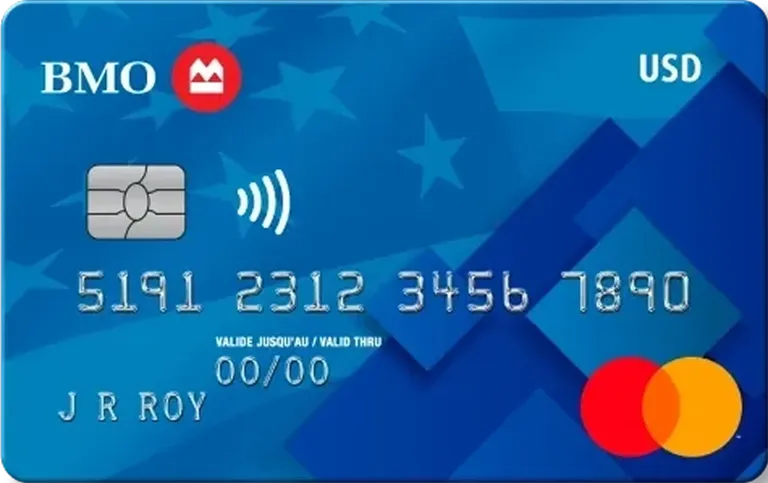
This is BMO's card for people who already live partly in U.S. dollars: snowbirds, cross-border shoppers, anyone paid in USD or holding U.S. savings. The account is in U.S. dollars, so a U.S. purchase shows up on the statement in the U.S. dollars you paid, and you pay it off in U.S. funds, with nothing converted at either end. I'd point it at someone who already has a U.S. dollar account to pay from.
What sets it apart from the other U.S.-dollar cards is the fee rebate: put US$3,000 a year on it and next year's US$49 fee comes back. It earns nothing, though, carries no travel insurance, and converts anything charged in Canadian dollars at the network rate plus 2.5%. So it's a second card for U.S. spending only.
Welcome offer
There is no welcome bonus on the BMO U.S. Dollar Mastercard, and no points or cash back to earn, so there is nothing to unlock at sign-up. BMO's product page shows the fee, the rates and the coverage, with no sign-up offer, as of October 15, 2026.
The nearest thing to an incentive is ongoing: when your purchases total US$3,000 or more in a year, BMO rebates the next year's US$49 annual fee. The year is the twelve months between annual fee-billing dates, and the credit lands on the same statement as the fee.
Work out your U.S.-dollar spending before applying. At US$3,000 a year (about US$250 a month) the card costs nothing from the second year on; below that, you pay US$49 every year for a card that only saves you conversion costs.
Fees & eligibility
The card costs US$49 a year; BMO's rates insert says fees and charges on its U.S. Dollar Mastercard are in U.S. dollars. The fee is charged on the first statement after the account opens and there is no first-year waiver, but it is rebated the following year whenever purchases total US$3,000 or more in the twelve months between fee-billing dates. Additional cardholders are free.
Purchases carry 21.99% interest and cash advances and balance transfers 23.99% (21.99% for Quebec residents), with an interest-free grace period of at least 21 days on purchases when you pay in full. Two missed minimum payments in 12 months raise the rates to 25.99% and 27.99% for at least 12 months. BMO lists no income figure, only that minimum income requirements apply, alongside being a Canadian citizen or permanent resident of the age of majority with no bankruptcy in the past seven years.
You pay the bill in U.S. funds: by transfer from a BMO U.S. dollar bank account, by pre-authorized debit from any U.S. dollar savings or chequing account in Canada, or by mail. BMO's Benefits Guide suggests using the Transfers function rather than Payments in online banking so your available credit updates right away.
Perks & benefits
The main perk is the billing currency: U.S. store purchases, U.S. online orders and anything else priced in U.S. dollars post at face value, and you settle the statement in U.S. funds. The second is the annual fee rebate once purchases reach US$3,000 in a year.
The extras are BMO's standard Mastercard ones: 20% off Cirque du Soleil shows touring Canada and 15% off resident shows in Las Vegas (booked through BMO's Cirque du Soleil link), free additional cardholders, BMO PaySmart installment plans on eligible purchases of $100 CAD or more (BMO's wording), and zero liability for fraudulent use. There is no lounge access, no travel credit and no rewards.
Insurance
Coverage is limited to purchase protection and extended warranty. Most items bought in full with the card are insured against theft or damage for 90 days, and the original manufacturer's warranty is extended by up to 1 year; the two share a $60,000 lifetime maximum per account, and the certificate states its amounts in Canadian currency.
One catch for cross-border shoppers: the extended warranty applies only when the original manufacturer's warranty is valid in Canada, wherever you buy the item. There is no travel insurance of any kind, no emergency medical, trip cancellation or rental car cover, which matters for snowbirds; BMO's page points you to its paid travel insurance instead.
My take
I'd get this card if you already spend at least US$3,000 a year in U.S. dollars and have a U.S. dollar account to pay it from; if you only visit the U.S. now and then, I'd skip it.
The job it does is narrow: U.S. purchases stay in U.S. dollars from the till to the payment, so nothing is converted on the way in or out. The fee rebate is what makes it worth a look against the other U.S.-dollar cards, because a regular U.S. spender ends up paying nothing from the second year.
The downsides are real, though. It earns no rewards, offers only purchase protection and extended warranty, and converts Canadian-dollar purchases at network rate plus 2.5%. TD's U.S. Dollar Visa costs US$39 and comes with travel cover, and RBC's U.S. Dollar Visa Gold costs US$65 and earns Avion points, so I'd compare all three against how much you actually spend in U.S. dollars.
The good
- Billed and paid in U.S. dollars, no conversion on U.S. purchases
- US$49 fee rebated after US$3,000 in purchases a year
- Free additional cardholders
The catch
- No rewards of any kind
- Canadian-dollar and other-currency purchases converted at network rate plus 2.5%
- No travel insurance, not even emergency medical