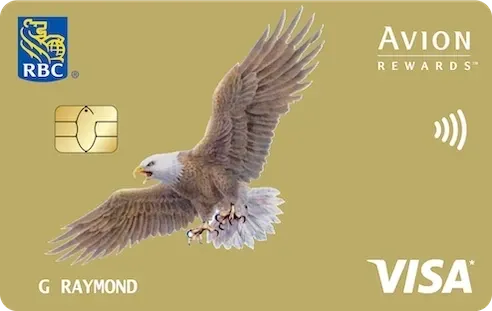
RBC's U.S. dollar card is the one I'd look at first if you spend real money in U.S. dollars and want something back for it. The account is billed in U.S. dollars, so U.S. purchases post without conversion, and every US$1 earns 1 Avion point. For snowbirds and cross-border shoppers who can pay the bill from a U.S. dollar account, it keeps the money in one currency from start to finish.
The return is modest: points are worth 1 cent per point (cpp) in Canadian dollars toward travel, and this card can't use points to pay bills or send e-Transfers. The fee is US$65 plus US$30 per extra card, and RBC's product page is silent on how purchases in Canadian dollars or a third currency are handled, which I'd want answered before using it outside the U.S.
Welcome offer
There is no welcome bonus on the RBC U.S. Dollar Visa Gold. RBC's product page shows the US$65 annual fee, the 1 Avion point per US$1 earn rate and the insurance, with no sign-up offer, as of October 15, 2026.
The category page carries a "limited time offer" caption, but the offer it describes is the card's standing feature (saving on foreign exchange while earning Avion points), not a points bonus.
With no bonus, the card has to earn its fee through U.S. spending. Estimate what you charge in U.S. dollars in a year: each US$1 is 1 Avion point, so the points only start to matter once that figure runs into the thousands.
Fees & eligibility
The card costs US$65 a year and US$30 for each additional card, both charged in U.S. dollars with no first-year waiver. RBC's card data shows no minimum income requirement.
Purchases carry 20.99% interest and cash advances 22.99% (21.99% if you reside in Quebec). The product page does not print a balance transfer rate, grace period or minimum payment, and it does not say what conversion fee, if any, applies to purchases in Canadian dollars or other non-U.S. currencies.
The balance is in U.S. dollars, so paying it from a U.S. dollar account keeps everything in one currency. RBC's card page does not explain how a payment from a Canadian dollar account is converted; you can also put Avion points toward the balance with Pay Credit Card with Points.
Earning rewards
Earning is flat: 1 Avion point per US$1 on qualifying net purchases, with no categories, caps or bonus multipliers. Cash advances, balance transfers, cash-like transactions, interest and fees earn nothing, and returns take back the points.
Points are earned per U.S. dollar but redeemed in Canadian dollars toward travel, so the return on what you spend is below 1% whenever the Canadian dollar trades below the U.S. dollar. Linking the card to Petro-Points adds 3 cents a litre off fuel and 20% more Petro-Points at Petro-Canada.
Redeeming rewards
Travel is the anchor: RBC says every 100 Avion points is worth $1 CAD toward travel booked through Avion Rewards, which is 1 cpp, and you can start redeeming at 2,500 points. The same points go to gift cards, merchandise (including Apple and Best Buy), RBC financial rewards such as investment contributions, or a payment toward the card balance.
Two limits are specific to this card. The Avion Rewards terms exclude the RBC U.S. Dollar Visa Gold from Pay Bills with Points, Interac e-Transfer with Points and Pay In-Store with Points. Points can still be converted to WestJet points at 1:1, with a 1,000-point minimum, into a WestJet Rewards account in your name.
Perks & benefits
The headline perk is the billing currency: transactions in U.S. funds post in U.S. dollars, so RBC says you avoid daily currency fluctuations on them. The rest are RBC's standard linked offers: 3 cents a litre off fuel and 20% more Petro-Points at Petro-Canada, 3x Canadian Tire Money with Triangle Rewards, 50 Be Well points per $1 at Rexall, and a 6-month DashPass subscription (activate before November 16, 2028).
You also get Avion Rewards offers from more than 2,000 brands. There is no lounge access, no travel credit and no status.
Insurance
The insurance covers the trip itself rather than your health. Trip cancellation pays up to US$2,500 per trip for all covered persons combined, and trip interruption up to US$2,500 per covered person, when you pay the whole trip with the card or Avion points; the certificate states these amounts in U.S. dollars. Delayed baggage reimburses up to US$500 per person (US$2,500 per occurrence) for essentials once checked bags are 4 hours late on a flight paid with the card.
Travel accident cover is up to $500,000 CAD on a common carrier, and auto rental collision/loss damage is primary for up to 48 consecutive days on vehicles with an MSRP up to $65,000 CDN, if you book and pay the full rental with the card and decline the agency's CDW. Purchase security covers items for 90 days (US$50,000 per account per calendar year), and extended warranty doubles the manufacturer's warranty by up to 1 extra year.
There is no emergency medical and no mobile device cover. RBC's page summary also mentions flight delay, but the certificate has no flight delay section, so don't count on it.
My take
I'd get this card if you spend steadily in U.S. dollars, can pay it from a U.S. dollar account and want points for it; if you only cross the border once or twice a year, I'd skip it.
The case over TD's U.S. Dollar Visa is easy to see: for US$65 against TD's US$39, you earn 1 Avion point per US$1 and pick up trip cancellation cover that TD's card lacks. If a few thousand U.S. dollars a year go through a U.S. dollar card, the points start to cover that gap.
The downsides: the return is thin at 1 cpp in Canadian dollars, points can't pay bills or fund e-Transfers from this card, there's no emergency medical, and RBC's page doesn't say what you pay on purchases outside U.S. dollars. I'd keep it strictly for U.S. spending and carry a Canadian-dollar card for everything else.
The good
- Billed in U.S. dollars, no conversion on U.S. purchases
- 1 Avion point per US$1 on every qualifying purchase
- Trip cancellation, interruption and primary rental car cover
The catch
- US$65 fee plus US$30 per additional card
- Points worth 1 cpp in Canadian dollars; no pay-bills or e-Transfer redemptions
- No emergency medical, and no published terms for non-U.S.-dollar purchases