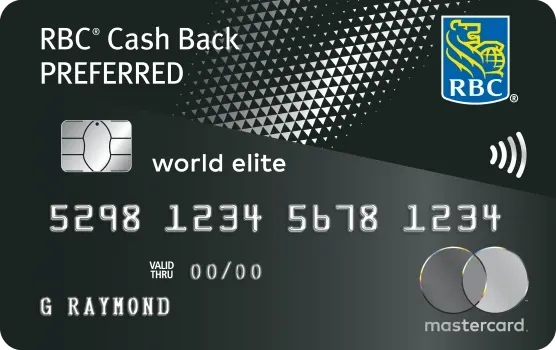
This is RBC's step-up cash back card, and the 2026 version is a much simpler pitch: 3% with no cap on groceries, dining and food delivery, gas and EV charging, transit and rideshare, and streaming and digital gaming, then 1% on everything else. I'd point it at a household that already banks with RBC and puts most of its spending into those everyday categories.
What I'd weigh is the $120 fee with no first-year waiver and the $80,000 personal income bar. You get real insurance for it, including 10 days of emergency medical and mobile device cover, but no trip cancellation or interruption, so it is a spending card with some travel backup rather than a travel card.
Welcome offer
RBC is offering 15% extra cash back on your first $2,000 in net purchases, including pre-authorized bill payments, during the first three months, verified on the RBC page on October 13, 2026. That is up to $300, paid on top of the standard rates, so a grocery or restaurant bill effectively earns 18% while the offer runs. Applications must be received by February 2, 2027.
The bonus is credited 4 to 6 weeks after each statement date in the three-month window, as long as the account is in good standing. It is not open to additional cardholders or to existing RBC personal cardholders switching into this card, it cannot be combined with other offers, and closing or changing the card before the bonus posts can cost you the bonus.
$2,000 in three months is about $667 a month, which most households reach with groceries, gas and recurring bills. The extra 15% stops at $2,000, so there is nothing to gain by pushing spending past that point for the offer.
Fees & eligibility
The card costs $120 a year, with no first-year waiver shown on RBC's page, and each additional card is $50. You need a minimum personal income of $80,000 or household income of $150,000. Purchases carry 21.99% interest and cash advances 22.99% (21.99% if you live in Quebec), and RBC's terms treat balance transfers as cash advances.
The product page does not state a foreign transaction fee, so check the cardholder agreement before using the card abroad. At 21.99% interest, any balance you carry costs far more than 3% cash back returns, so the card only pays if you clear the statement each month.
Earning rewards
Cash back is earned at two rates with no caps: 3% on groceries, dining and food delivery, gas and EV charging, transit and rideshare, and streaming and digital gaming, and 1% on everything else, including pre-authorized bill payments.
The 3% categories are set by merchant category code. Groceries means grocery stores and supermarkets (MCC 5411), so big-box stores or pharmacies that sell food may earn 1%. Dining covers restaurants, bars and fast food but not government liquor stores, transit covers local commuter transit, taxis and rideshare but not intercity trains or buses, and streaming covers digital media, apps, games and pay-TV or streaming services, with gambling excluded.
Redeeming rewards
Cash back is paid as a statement credit to the card. Until December 1, 2026 you request it by phone once the balance reaches $25, and the whole balance is credited. From December 2, 2026, RBC's program terms let you redeem any amount from $1, in full or in part, through Online Banking, the RBC Mobile app or by phone.
The product page also mentions an automatic credit every January, but RBC's current program terms say cash back on its personal Mastercard accounts, this card included, is not credited automatically and accrues until you ask for it. A credit does not count toward your minimum payment.
Perks & benefits
The most practical perk is a 12-month complimentary DashPass from DoorDash ($0 delivery fees on eligible orders of $15 or more), on RBC's list of cards that get the longer subscription. Link the card at Petro-Canada for 3 cents per litre off fuel and 20% more Petro-Points, at Triangle Rewards for 3X Canadian Tire Money, and at Rexall Be Well for 50 points per $1.
As a World Elite Mastercard it comes with a Mastercard Travel Pass membership by DragonPass covering 1,300+ airport lounges, plus The Mastercard Collection and Mastercard Travel Rewards offers abroad. RBC's page lists no complimentary lounge visits, so treat Travel Pass as a membership rather than free access. There is no travel credit.
Insurance
The insurance package is broader than most cash back cards carry. Emergency medical is unlimited for the first 10 days of a trip if you are under 65 (3 days at 65 or older), with no requirement to charge the trip to the card, and a top-up is available for longer trips. Flight delay pays up to $500 per occurrence after 4 hours, delayed baggage up to $500 per person, and rental car collision cover applies to vehicles up to $65,000 MSRP for up to 48 days.
Mobile device insurance covers a phone or tablet bought with the card for up to $1,500 per claim for two years, and purchase security runs 120 days with extended warranty tripling the manufacturer's warranty by up to two years. There is no trip cancellation, trip interruption or travel accident cover.
My take
I'd get this card if you earn over the income bar and spend heavily on groceries, dining, gas and streaming; if you want no fee or travel points, I'd skip it.
What I like is how wide the 3% net is: groceries, restaurants, food delivery, gas, EV charging, transit, rideshare and streaming all earn it with no cap, and the base is a full 1%. Compared with RBC's no-fee Cash Back Mastercard, which pays 2% on groceries and 0.5% on most other spending, the gap on dining, gas and streaming alone can cover the $120 fee for a busy household.
The fee is the catch: $120 every year, no first-year waiver, and $50 per extra card. I'd also not buy it for travel. Ten days of medical and delay cover are good backup, but without trip cancellation or free lounge visits a travel card does more for frequent flyers.
The good
- Unlimited 3% on groceries, dining, gas, transit and streaming, 1% on the rest
- Extra 15% on the first $2,000 for three months (up to $300)
- Emergency medical, delay, rental car and $1,500 mobile device cover
The catch
- $120 annual fee with no first-year waiver; $50 per additional card
- Needs $80,000 personal or $150,000 household income
- No trip cancellation or interruption; lounge access is pay-per-visit membership only